Saturday, July 2, 2022

TWO REVOLUTIONARY ICONS

In my mind, there are two iconic, revolutionary hihat models in modern cymbal history. One is the Avedis Zildjian New Beat. It debuted in the early 1960s, was the first to pair a medium top with a heavy bottom, and became the defacto standard for hihat sounds. I first heard one up close from a US Navy show band at UP Abelardo Hall, and immediately fell in love. It had a distinct "chiff" sound when pedaled and buttery sustain when half-open. I saved up all my gig money and eventually got them in 1975 from Salonga's Music Cubao for 650 pesos, a princely sum at the time. Based on info in black.net.nz, mine are a late 1st generation version from the early 70s. This was just before Zildjian started making cymbals heavier to serve the rock music market, and when the variances in weights within a model was widest. Mine had a particularly light top weighing in at only 782 grams, and the bottom at 1223 grams. This combination made them sound more airy than all other New Beats I had played on backline kits. They originally came with a trendy sticker and ink labels indicating which was the top and which was the bottom. The sticker has long disintegrated from wear, and all that is left of the ink label is this vague outline in the inside of the bottom hat. But graphics aside, I have been perfectly content with the sound and feel, for they were everything I needed and wanted. 


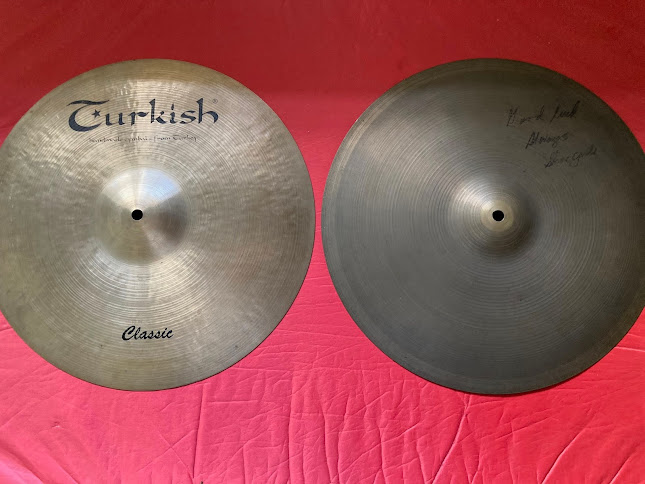
The second icon is the Paiste 2002 Sound Edge. Introduced in the early 1970s, this uses a bottom with rippled edges which prevents airlock, creates a firm "chip" sound when pedaled, and an aggressive sustain when half-open. Unfortunately, they have not always been freely available locally, and were so expensive I couldn't afford them when I was younger. Heck, I can't even afford them brand new now either. So when a pair popped up this past week in the FB Marketplace for less than half the going rate of a used pair, I got curious. What would it be like to have both New Beats and Sound Edges? Adding to the allure was that these are coveted vintage "black label" 2002's. Resistance proved futile, and I grabbed them immediately. The serial numbers revealed the production dates at 1981 for the top and 1979 for the bottom. I usually prefer light cymbals, and this pair falls perfectly in the lighter side of otherwise ultra-consistent Paiste quality control, 826 grams for the top, and 999 grams for the bottom. As I had hoped, the Sound Edges are the perfect counterpoint to my New Beats.


Zildjian and Paiste eventually copied each other. Many of Paiste's hihats now bear a similar top/bottom weight ratio as the New Beats, and Zildjian created their own Mastersound series with rippled bottoms. But now I have both of the originals. To celebrate my double contentment, I spent an afternoon giving both the full spa treatment of cleaning and buffing. Hihats have not figured in new rhythms I've been working on, but I may be inspired to give them a little more attention. 

Friday, June 24, 2022

MY 10" JOURNEY

I’ve had a couple of 10” snares. The first was a Pearl Short Fuse , which was replaced by a Pearl Firecracker. While the metallic, ringy, rambunctious Firecracker was a blast to play, I missed the Short Fuse's happy wooden pop. 

A few days ago a mint condition Pearl M1060 “Popcorn” 10" x 6" snare showed up on the Facebook Marketplace going for half the price of a new one. This is the most expensive 10” model in Pearl’s current lineup. The 6-ply maple shell, 2.3mm Superhoops, and Masters lugs scream quality. I messaged the seller asking to trade with my Firecracker. No go. I asked for a discount. No go again. When he said he had another inquiry on the line, I jumped. Down payment that night, then balance the next day upon pickup? Deal! The seller tempted me with an extra soft case and I bit. Full payment and courier pick up followed the next morning. 

When it arrived and without tuning, it sounded like a timbale. All drum and no snare. After fiddling around, I found the snare wires only respond within a narrow range of tightness. This is unlike any other snare I’ve ever had. But once it’s dialed in, the characteristic happy pop of a wood snare is joined by a slight throatiness due to the added depth, and is focused due to the maple shell and heavier 2.3mm hoops. I put on a new Ambassador coated batter and Puresound Blaster 10" 16-strands. Perfect!

The Firecracker is on sale now that this Popcorn has taken its place.  I usually say “never say never”, but this may just be the last stop on my 10” journey. 

--------------------

UPDATE 1

The Firecracker got sold to a musician wanting a snare for his 5-year old nephew. Cute :-)

----------------

UPDATE 2

I changed the Aquarian snare side to an Evans Snare Side 200. The drum now has a ring, something I look for in a snare sound. 


Friday, June 3, 2022

MY FIRST LUDWIG


This is another "one that got away" story that fortunately had a happy ending. Just when I thought my snare collection was complete, not just one, but two circa-1980s Tama Artwood Maple 14-ply (!) 14x8 surfaced in the FaceBook Marketplace. One was cheap but in rough shape, the other in better shape and 5k pesos more. The only thing that made me hesitate was the thickness. 14 plies means the shell will be very stiff and better for high tuning. 
I have enough smaller snares for that, and therefore wanted it for lower tuning. By the time I decided to pull the trigger, both had already been sold. Lurking in the background of Facebook was a circa-2000s Ludwig 14x8 Classic Hybrid Oak/Maple in mint condition. More expensive than the Tama's, but negotiable. I justified this as an advanced prize for surviving another school year, contacted the seller, got the price down to Reverb USA levels, and paid GCash on delivery. 

It came tuned high and already sounded nice, like a darker version of my Pearl Masters Brass. It arrived with 2.3mm triple-flanged hoops, Remo Ambassador batters, and Remo Diplomat snare side heads. Since I wanted to use it as a fat snare/tom, I swapped them for a heavier Evans Hydraulic batter and Remo Ambassador Snare Side, and it was not quite what I wanted. So I put the Ambassador batter back, threw on a BigFatSnareDrum, and tuned it low. Much better, and this made it easier to switch between a "normal" snare and a "fat" one. After changing heads, I was able to dial it in to snom territory in no time. Of all my 14" snares, this is the easiest to tune. 

On the hardware side, the throw is supposed to be a P-85 but looks more like a cheap replacement. The P85 is notorious for sticking when you're in a hurry, so the previous owner must have swapped it out. But the locking bar was apparently left out, and the cord was merely tied to the strainer. Thankfully, I keep all my old parts and screws that have been replaced. I dug up an bar from an old Pearl SR017 and a couple of unused lug screws. Problem solved. It's not pretty, but it works. The moral lesson is: keep you old parts, even if they're broken. You never know when you'll need them.  The butt plate is an original P-32 though. They both use flat-head screws to secure the snare strings, which I find sadly archaic. The original snares had a couple of misaligned wires, so I got new Gibraltar 20-strands for it. The shell is immaculately finished in and out, and there is absolutely no rust on any of the hardware. 

This may seem like the odd-man-out in a sea of Pearl drums. I'm not close-minded about brands though. It just turned out that way. I prefer the hardware of contemporary Pearls. But Ludwig shell finishing is second to none. I can't wait to hear what this will sound like in a recording. 

------------------------

UPDATE
I got an INDe throw off and butt plate a month later. They were a breeze to install, and work flawlessly. Then I discovered a strange after-buzz. Tightening all the lug screws solved the problem. I don't know if this is the norm, but it seems Ludwig makes fantastic shells, but their hardware and hardware-related QC is wanting. 

Thursday, October 21, 2021

A SOUND OF ITS OWN


I'm not sure if Steve Gadd said it first, but I agree that each instrument in a drum set should have a voice of its own, despite being part of one kit.  My 12"x9" rack tom made its way to a recording released last month, and it sounded really nice. The tuning were spot on. But the more I played it, the more it sounded too close to my 14"x10" floor snom in pitch and timbre. This made me consider selling it and just settling on a snare/floor/kick combination. 

A week later, I saw an ad for a mint-condition Pearl Decade Maple 10"x7" in Gloss Deep Red Burst. Was this the solution to my dilemma? I've always had a soft spot for 10s, but never owned one. So this was my chance. I struck a deal with the seller to trade my old 12" for his much newer 10", and I'd add cash. It took a day before the seller accepted the trade, and things moved quickly after.  Shipping took three days because he was in Pampanga. After carefully peeling off several layers of bubble wrap, the perfunctory anti-viral alcohol rub taking care not to ruin the wood finish, and an overnight quarantine, I took it up to the drum room, replaced the batter head with a used Ambassador, and tuned it one full turn just above wrinkle. It has a very happy, excitable character, an interesting contrast to the throaty Midtown kick, laid back snom, and the poppy Omar Hakim snare. In addition to needing some time to figure out how to use it musically, I'm also thinking of what new heads will give it an even more unique voice and feel to the stick. All my snares have coated heads, and my floor snom and kick have Fiberskyns. Hmmmmmmm. Could clear heads make it different? How about Pinstripes? I'll probably end up getting both during my fortnightly shopping run. 

Whichever head/tuning combination I eventually choose, my bop kit is now a bonafide frankenkit. Each drum has a unique color/finish, sound, and feel. 

P.S.1 July 2022 -  I eventually settled on Ambassador coated batter and Ambassador clear reso. It sings even with a drum mute on top.  


Midtown poplar kick drum 16” x 14” Black Gold Sparkle
Competition mahogany marching snare (CMS-1410) 14” x 10” Chrome
Decade Maple tom 10” x 7” Gloss Deep Red Burst
Omar Hakim African Mahogany Signature Snare (OH1350) 13” x 5” Natural Mahogany


Friday, June 4, 2021

A CHANGE OF DIRECTION

It was the deal of the century. Late 1980s Yamaha Recording Custom shells (12/13/16/22) in piano black, 14"x6" Recording Custom steel snare, A. Zildjian 20" medium ride, 18" medium-thin crash, and 14" New Beats, in good condition, for just 30k pesos! I was so close to snagging the deal when the wife of the seller suddenly asked not to go through with it, claiming the kit was bought for their children and should not have been offered for sale in the first place. The seller got back to me, saying he needed the money badly for his business, and that it was his decision to make. But I didn't want to get between spouses, so I brokenheartedly called the whole thing off. 

The consuelo de bobo of this failed transaction was that it got me thinking. Why should I get another kit with similar dimensions, since I have don't have the space for another one unless I dispose of my existing one, which I am reluctant to do for sentimental reasons. So after mourning the failed deal, I saw a 16" Pearl Midtown bass drum with case in the FB Marketplace. I thought, why not put together something completely different, like a bop frankenkit? What the hell is that you may ask. OK, there are 2 parts to that. A bop kit has everything an ordinary kit has, but features a small bass drum. This is because New York jazz musicians who played bop music in small clubs had to carry their entire kit on the subway by themselves, to gigs in small clubs with a very tight stage. Since the bass drum was the biggest component of the kit, they opted for smaller ones, from 16" to 18" in diameter. On the other hand, a frankenkit it made up of mismatched components, either with different colors, or finishes, or brands, hence the similarity to Frankenstein. If I got the Midtown bass, I already had a choice of snares from my collection, my recently acquired 14" snom, and could get the 12" rack tom from my old kit. But a few days after I got the Midtown, I saw a nice 12" tom on sale for next to nothing. So I got that too. Unintentionally, all the drums are once again made by, you guessed it, Pearl. Whatever. 

So my bop frankenkit has the following, a 16" x 14" Midtown kick, a 14" x 10" CMS-1410 “Competition” mahogany marching snare as a snom, and a 12" x 9" Ranger II rack tom. I installed new-old-stock Remo Fiberskyn heads that I got years ago in the Salonga's Cubao closeout sale. It took a whole day to dial in the sound of kick drum. I tried all sorts of head and muffling combinations, and finally settled on Fiberskyns, with no muffling, and at medium tuning. 

Now I have two kits occupying only the space of one and a half. A classic 12/16/22 that will stay at home, and the bop 12/14/16 that can go on gigs .... after the pandemic. 


Midtown poplar kick drum 16” x 14” Black Gold Sparkle
Competition mahogany marching snare (CMS-1410) 14” x 10” Chrome
Ranger II Poplar tom 12” x 9” Chrome
Omar Hakim African Mahogany Signature Snare (OH1350) 13” x 5” Natural Mahogany


Sunday, May 2, 2021

A TALE OF TWO SIXTEENS


I find it strange that none of my collection of "Turkish" type cymbals was actually made in Turkey. I've heard some nice Istanbul Mehmet cymbals at Lazer, but except for a 22" Legend Ride which I couldn't afford, none of them are that different from my old A Zildjians. There are usually Bosphorous cymbals in the FB Marketplace, but are priced rather high. And Istanbul Agops are very rare here because they have no local distributor. 

One of my all-time favorite cymbals was my 1978 A Zildjian 16" thin crash, affectionately called "steve god" by drummer friends because it had been autographed by THE Steve Gadd. Unfortunately, the sound has has deteriorated considerably due to mishaps and a period of extremely hard playing. (Its complete history is in an earlier post)  I thought of "retiring" it, but I have no other cymbal in that size and range. And if I did get another 16", I wouldn't want a replacement, but something with its own unique voice.  

So last week when I saw a Turkish (yes, that's the brand name) 16" thin crash, I became intrigued. It was made in Turkey, check. It was a 16" thin crash, check. Potentially darker sounding, check. No issues, check. Priced right, CHECK! And the seller actually bought it in a store next to the factory in Istanbul. The only problem was it would be coming from Cavite. But I figured it was a Sunday, so there would be less traffic. And it was small enough to fit in a motorcycle, so shipping would be cheap. It took a couple of hours to get here, and was given a soap and water bath as soon as it arrived. It weighs 921 grams, has a funky complex wash, and a nice smooth sustain. It's not particularly "dark" sounding, but is distinct enough from my A Zildjian 18" thin crash which it will usually partner. Buying a cymbal without hearing it first is a risk. Thankfully this risk paid off. 

Steve god can finally rest from crash duties. He's earned it. But he will come out occasionally to serve as an alternative hihat top together with a Stagg SH China bottom.


Saturday, April 24, 2021

ANOTHER PEARL?

I've acquired a lot of snares these past few years. The one thing I lacked was a real, honest to goodness fat snare. So when I saw this in the Facebook Marketplace, I was immediately drawn to it. The dimensions were perfect for what has become popular in the past few years, the hybrid fat snare / floor tom. Web searches suggested this is a 1990s 14”x10” Pearl CMS 1410 "Competitor" Mahogany Marching Snare.  

The seller was in Pampanga, and the drum had to shipped by cargo. But he was enthusiastic and easy to deal with. So after a failed, then a subsequently delayed attempt to transfer payment online, things were ironed out and the drum arrived two days later. After required alcohol disinfection, I wiped down the hoops, installed new Evans Hydraulic batters and Remo Ambassador Snare heads, and cleaned and lubricated all the tension rods. It now sits between the kick drum and the 16" floor tom. I'm still dialing in the perfect tuning, but it's already pretty close to what I want. 

You might be wondering if I'm a Pearl endorser, as all my drums are made by them. I swear it isn't intentional. It just ended up that way by chance. Whatever, since everyone is still stuck here working at home because of Covid 19, I won't be able to play out with this big boy. But until I get some time alone her at home, it will be interesting discovering how sensitive it will be at low volumes.